
Nisbita Benarji
The guards thought the woman in the laundry hut was going deaf. Every day she hummed the same church hymns to herself. Twenty-five years later, veterans learned those hymns had carried hundreds of lives through a prison camp.

The prisoners called her Mama Elise.
The Germans called her useless.
Elise Bauer was 61 years old in 1944 when the Nazis forced her into labor at Ravensbrück concentration camp, the largest women’s camp in the Third Reich.
Before the war, she had been a church organist in Leipzig.
A widow. No children. Small hands twisted with arthritis from decades at piano keys and hymn books. She had spent most of her life teaching music to village children and leading Sunday services while the rest of Europe marched toward madness.
Then her younger brother disappeared after criticizing Hitler at a factory meeting.
Weeks later, the Gestapo arrived for Elise too.
Not because she fought.
Because she refused to stop asking where he had gone.
By winter 1944, she sorted uniforms inside the camp laundry barracks alongside starving prisoners from across Europe — Poles, Frenchwomen, Russians, Jews, political prisoners, resistance couriers.
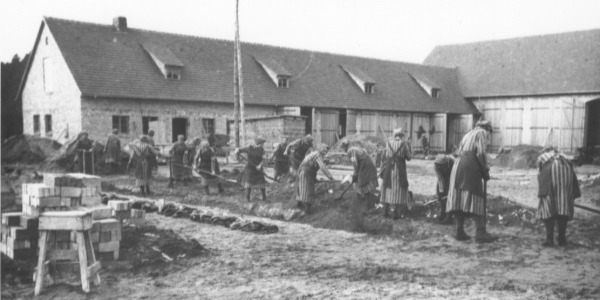
Every day she stood over vats of boiling water while guards screamed numbers and orders around her.
And every day, she hummed hymns.
Softly. Constantly.
The guards mocked her endlessly.
“There goes the old church bird again.”
“She’s forgetting where she is.”
One officer laughed that she was “already halfway in the grave singing herself there.”
Elise lowered her eyes and kept humming. That was exactly what she wanted.
Because the hymns were not hymns anymore.
They were messages.

Ravensbrück processed thousands of women through forced labor factories tied to German military production. Prisoners disappeared constantly — transferred, executed, sent to medical experiments.
Nobody knew who was alive. Nobody knew which transports meant death.
But laundry traveled everywhere. Uniforms from factories. Coats from prison blocks. Bandages from infirmaries.
And Elise noticed something no guard bothered tracking: every prisoner listened when someone sang.
So she built a code hidden inside old Lutheran melodies.
Specific hymns identified barracks.
Tempo changes signaled executions.
Repeated verses warned of selections.
Names of saints replaced names of prisoners scheduled for transfer. Even the pitch mattered.
High key meant danger near the north compound.
Low key meant guards were distracted.
At first, only a handful of prisoners understood.
Then the code spread quietly across Ravensbrück.
A French resistance prisoner later wrote: “We learned to hear survival hidden inside church music.”

One evening, a terrified teenage Polish prisoner arrived at the laundry barracks after hearing rumors of medical sterilization experiments.
She asked Elise in whispers if the stories were true.
Elise did not answer directly. Instead, while folding uniforms, she began humming Ein Feste Burg unusually slowly.
Three repeated notes. Pause. Then the final verse twice.
The girl’s face went pale.
Because prisoners already knew what that pattern meant: Do not report to infirmary. Hide tonight.
Hours later, SS doctors entered her barrack searching for women selected for experiments.
The girl escaped through a coal chute moments before they arrived.
Again and again, Elise’s songs moved warnings faster than written notes ever could.
When guards prepared surprise searches, the melodies changed.
When transports left for Auschwitz, prisoners heard it in the rhythm before official announcements came.
When Allied bombing neared nearby factories, Elise shifted into funeral hymns to warn prisoners working outside.
The guards never understood because old women singing to themselves sounded harmless.
Especially tired old women whose hands shook constantly while they worked.
Then came February 1945. Germany was collapsing. Russian forces moved westward.
The SS began evacuating camps, executing prisoners too weak to march.
One afternoon, Elise overheard officers discussing a liquidation order for several barracks filled with sick women before retreating from Ravensbrück.
Hundreds could die before liberation arrived.
She needed the warning across the camp immediately.
That night, while prisoners lined up for evening count beneath freezing rain, Elise did something witnesses never forgot.
She sang loudly. Not humming anymore. Singing.
An old church hymn called Wachet Auf — “Awake.”

Again and again she repeated one verse unnaturally fast while staring toward the infirmary barracks.
Prisoners understood instantly. Move the sick women now.
Throughout the night, women quietly shifted prisoners between barracks, hiding the weakest beneath laundry carts, inside storage rooms, beneath piles of uniforms waiting for transport.
By morning, SS guards entering the infirmary found dozens fewer prisoners than expected.
Chaos erupted. Arguments. Miscounts. Delays.
Then artillery thundered in the distance.
The evacuation order collapsed before executions could begin.
Soviet troops liberated Ravensbrück weeks later.
More than seventy women later testified that Elise’s warnings saved their lives.
But the strangest moment came after liberation.
Former prisoners gathered around her outside the camp gates while exhausted survivors sat wrapped in blankets listening silently.

Someone asked Elise how she created such a complicated system without being discovered.
The old woman smiled faintly.
Then she answered: “Men who believe you are weak stop listening carefully.”
After the war, survivors tried honoring her publicly.
Elise refused almost every ceremony. “I only sang songs,” she insisted.
But women from Ravensbrück disagreed.
A Czech survivor named Marta Veselá later said: “No. She carried messages inside music the way others carried them inside radios or guns.”
Elise returned to Leipzig after the war.
The church where she once played organ had been damaged by bombing, but one keyboard survived beneath dust and broken plaster.
For years afterward, survivors occasionally visited Sunday services just to hear her play again.
Some cried before the first hymn even ended.
Because for them, those melodies no longer meant church.
They meant warning.
Hope.
Another morning survived.
Elise Bauer died quietly in 1973 at age 90.

At her funeral, former Ravensbrück prisoners traveled from six countries carrying faded hymn books instead of flowers.
Inside many of the books, they had written dates beside certain songs.
Dates when lives were saved.
Dates when danger passed.
Dates when an old woman pretending to lose her hearing quietly outsmarted one of the cruelest systems ever built.
And somewhere in survivor testimonies remains one of the strangest resistance networks of World War II:
A prison camp intelligence system hidden inside the voice of a grandmother singing hymns no one thought important enough to silence.

She never carried a weapon, never raised her voice… but what she did inside that camp still amazes people today →:
https://ifeg.info/…/the-woman-they-thought-was-going…/