Exodus 32:15-24 Click here for Bible Verses
Hi GAMErs!
Today’s passage is Exodus 32:15-24. Let’s go!
Exodus 32:15-16 (NIV)
15 Moses turned and went down the mountain with the two tablets of the Testimony in his hands. They were inscribed on both sides, front and back.
16 The tablets were the work of God; the writing was the writing of God, engraved on the tablets.
On verses 15-16: Moses returns from the mountain carrying in his hands the most precious thing given to humanity up until that time: two tablets containing the writing of God. What did God write on those tablets? It was “the Testimony”, that is (most likely) the Ten Commandments. Some scholars believe that these two tablets, which had writing on both the front and back, were identical to one another and were two copies of the same thing, one for God and one for the people, consistent with ancient Near East covenant making practices at that time.
There was nothing more valuable on the earth at this time that these two tablets. God wrote His law on tablets of stone. Later He choose another method of delivering His Word to His people: instead of writing it on breakable tablets of stone, God would choose to write it on breakable human hearts (see 2 Corinthians 3:3). For when a stone tablet breaks, whatever was written of it can’t be seen anymore. But when a heart breaks, whatever was written on it will be seen more clearly than ever.
Exodus 32:17-20 (NIV)
17 When Joshua heard the noise of the people shouting, he said to Moses, “There is the sound of war in the camp.”
18 Moses replied: “It is not the sound of victory, it is not the sound of defeat; it is the sound of singing that I hear.”
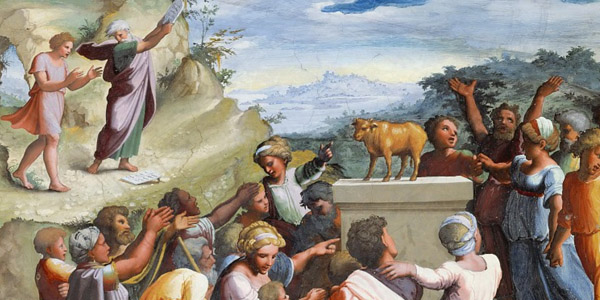
19 When Moses approached the camp and saw the calf and the dancing, his anger burned and he threw the tablets out of his hands, breaking them to pieces at the foot of the mountain.
20 And he took the calf they had made and burned it in the fire; then he ground it to powder, scattered it on the water and made the Israelites drink it.
On verses 17-20: Moses and Joshua hear the people shouting wildly, only to find that the people were reveling in the worship of a golden calf. Angry, Moses throws the tablets containing the Testimony out of his hands, breaking them at the foot of the mountain. Was this an impetuous decision by a hot-tempered Moses? Not necessarily. While it is true that Moses showed signs of losing his cool from time to time, a good argument can also be made that throwing and breaking the tablets was a thoughtful and intentional decision on Moses’ part. By throwing and breaking the tablets, Moses was publicly symbolize how the people had completely broken faith with God, as if to say, “Why even bother having these tablets anymore when you have already broken the vey first commandment, which is not to have any other gods before the LORD.”
Moses then burns the calf in the fire, showing that the calf of course is no god at all. Moses also grinds it into powder and makes a golden calf shake for all the Israelites to drink, as part of them bearing the consequences for their sin.
What can we learn from this? When people sin in a very public and major way, the people’s leaders need to publicly express their dismay and anger over that sin, doing so thoughtfully. Don’t just hold it in and never speak on the issue. The people you lead need to hear what you think and see how you feel about that sin.
Exodus 32:21-24 (NIV)
21 He said to Aaron, “What did these people do to you, that you led them into such great sin?”
22 “Do not be angry, my lord,” Aaron answered. “You know how prone these people are to evil.
23 They said to me, ‘Make us gods who will go before us. As for this fellow Moses who brought us up out of Egypt, we don’t know what has happened to him.’
24 So I told them, ‘Whoever has any gold jewelry, take it off.’ Then they gave me the gold, and I threw it into the fire, and out came this calf!”
On verses 21-24: In Exodus 32:1-9 Aaron is described as actively participating in the creation of this golden calf. Yet in verses 21-24 Aaron tries to come across as a passive bystander to the people’s sin, blaming the people while minimizing his own responsibility.
What can we learn from this? When you make a mistake, own up to it and learn from it. As Pastor Craig Groeschel aptly puts it, “Most leaders could learn from their mistakes if they weren’t so busy denying them.” People will respect us far more when we own up to our failures and learn from our mistakes rather than pretending we didn’t do anything wrong.
Jesus, I am amazed by Your humility. Whereas we tend to deny our failures and blame others for our mistakes, You took on our failures and mistakes as Your own and You died on the cross for all my sins. Thank You for being the most amazing leader. In Jesus’ name, AMEN!