
Isaiah 36:1-37:7 Click here for Bible Verses
Hi GAMErs!
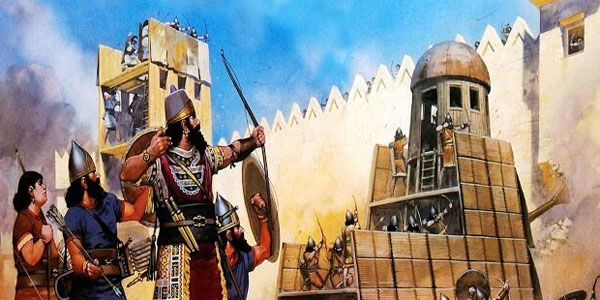
Today’s passage is Isaiah 36:1-37:7. Let’s go! Isaiah 36-39 is a small but dramatic section of history sandwiched between large sections of prophecy from Isaiah 1-35 and Isaiah 40-66. Isaiah would have had first hand knowledge of the events that he writes about in Isaiah 36-39, since he figures as an important character in all these events. Isaiah’s writings of these events would also make it into the royal annals of Israel, as shown in 2 Kings 18-20. In addition to describing some important history, Isaiah 36-39 teach us many valuable lessons for us today.
Isaiah 36:1-3 (NIV)
1 In the fourteenth year of King Hezekiah’s reign, Sennacherib king of Assyria attacked all the fortified cities of Judah and captured them.
2 Then the king of Assyria sent his field commander with a large army from Lachish to King Hezekiah at Jerusalem. When the commander stopped at the aqueduct of the Upper Pool, on the road to the Washerman’s Field,
3 Eliakim son of Hilkiah the palace administrator, Shebna the secretary, and Joah son of Asaph the recorder went out to him.
On verses 1-3: Over and over Isaiah had prophesied that the Assyrians would lay waste to much of Judah (e.g. Isaiah 7:17-20; 8:7-8) and that an alliance with Egypt would not help them (e.g. Isaiah 31:1-3). Here in 701 B.C., we see Isaiah’s prophecies coming true as Sennacherib king of Assyria captures all the fortified cities in Judah (46 of them, according to King Sennacherib’s own records). Now all that remains is the capital city of Jerusalem. So King Sennacherib sends his field commander with a large army to Jerusalem.
Upon arriving at Jerusalem, Assyria’s field commander stands on the aqueduct of the Upper Pool. This is significant because decades earlier in Isaiah 7, King Ahaz of Judah, fearing an attack by Assyria, stood on that same aqueduct, probably worrying about the water supply. There Isaiah, together with his son, met King Ahaz to encourage him with God’s Word. However, King Ahaz pushed God and Isaiah away. In response Isaiah told King Ahaz that one day the Assyrians would attack Jerusalem (Isaiah 7:17). Sure enough, about 30 years later in 701 B.C., the Assyrian field commander stands on the same aqueduct, ready to attack Jerusalem.
God’s Word is true. If God says it will happen, you can count on it to happen.
Isaiah 36:4-10 (NIV)
4 The field commander said to them, “Tell Hezekiah, “‘This is what the great king, the king of Assyria, says: On what are you basing this confidence of yours?
5 You say you have strategy and military strength–but you speak only empty words. On whom are you depending, that you rebel against me?
6 Look now, you are depending on Egypt, that splintered reed of a staff, which pierces a man’s hand and wounds him if he leans on it! Such is Pharaoh king of Egypt to all who depend on him.
7 And if you say to me, “We are depending on the LORD our God”–isn’t he the one whose high places and altars Hezekiah removed, saying to Judah and Jerusalem, “You must worship before this altar”?
8 “‘Come now, make a bargain with my master, the king of Assyria: I will give you two thousand horses–if you can put riders on them!
9 How then can you repulse one officer of the least of my master’s officials, even though you are depending on Egypt for chariots and horsemen?
10 Furthermore, have I come to attack and destroy this land without the LORD? The LORD himself told me to march against this country and destroy it.'”
On verses 4-10: Before attacking the people of Jerusalem with their swords, the field commander tries to beat the people of Jerusalem down with his words. In a trash talking tirade for the ages, the field commander tries to shake the confidence of King Hezekiah and his army. Rudely referring to Judah’s king as “Hezekiah” rather than King Hezekiah, the field commander gives four reasons why King Hezekiah should just surrender rather than fight against Assyria. To paraphrase those four reasons:
– First, “you can’t rely on Egypt!” (v6).
– Second, “the LORD is not going to help you. The LORD is angry at you after you removed his altars from the high places!” (v7)
– Third, “you don’t have enough soldiers or weapons to fight with!” (v8-9)
– Fourth, “God told us to destroy this place” (v10)
While some of what the field commander was saying was off base, what made the field commander’s trash talking intimidating is that some of what he was saying was true. Judah’s alliance with Egypt had proved useless. Judah was severely outnumbered and outgunned. And God has said that Assyria would bring much destruction to Judah. However, God also promised to rescue Jerusalem, and that is the promise that Hezekiah was hanging onto.
Isaiah 36:11-20 (NIV)
11 Then Eliakim, Shebna and Joah said to the field commander, “Please speak to your servants in Aramaic, since we understand it. Don’t speak to us in Hebrew in the hearing of the people on the wall.”
12 But the commander replied, “Was it only to your master and you that my master sent me to say these things, and not to the men sitting on the wall–who, like you, will have to eat their own filth and drink their own urine?”
13 Then the commander stood and called out in Hebrew, “Hear the words of the great king, the king of Assyria!
14 This is what the king says: Do not let Hezekiah deceive you. He cannot deliver you!
15 Do not let Hezekiah persuade you to trust in the LORD when he says, ‘The LORD will surely deliver us; this city will not be given into the hand of the king of Assyria.’
16 “Do not listen to Hezekiah. This is what the king of Assyria says: Make peace with me and come out to me. Then every one of you will eat from his own vine and fig tree and drink water from his own cistern,
17 until I come and take you to a land like your own–a land of grain and new wine, a land of bread and vineyards.
18 “Do not let Hezekiah mislead you when he says, ‘The LORD will deliver us.’ Has the god of any nation ever delivered his land from the hand of the king of Assyria?
19 Where are the gods of Hamath and Arpad? Where are the gods of Sepharvaim? Have they rescued Samaria from my hand?
20 Who of all the gods of these countries has been able to save his land from me? How then can the LORD deliver Jerusalem from my hand?”
On verses 11-20: Not wanting the soldiers defending Jerusalem to be more disheartened, Hezekiah’s top officials ask the field commander to stop speaking in Hebrew, which the Jerusalem soldiers could understand, and to speak in Aramaic instead. But the field commander refuses and begins to shout in Hebrew in the hearing of all the soldiers in Jerusalem. He tells them not to trust Hezekiah (v14-15), to make peace with the Assyrian king Sennacherib (v16-17) and to remember that so far no god has been able to deliver their nation from the Assyrians (v18-20).
The fact that the Bible records the Assyrian field commander going on and on trash talking this way, insulting God and blaspheming, suggests to me that we can talk, boast, blaspheme and criticize all we want, but God will always have the last word.
By the way, in verse 19 the field commander mentions how Assyria had conquered Samaria, the capital of the northern kingdom of Israel. This happened about 20 years before in 721 B.C. The field commander thinks that Samaria worshiped the gods of Hamath, Arpad and Sepharvaim (v19). Either he was mistaken or it goes to show how idolatrous Samaria was at that time, so much so that outsiders thought that Samaria actually worshiped the gods of Hamath, Arpad and Sepharvaim. How about you? When others who know you well say that you worship? Jesus, or someone/something else?
Isaiah 36:21 (NIV)
21 But the people remained silent and said nothing in reply, because the king had commanded, “Do not answer him.”
On verse 21: Sometimes the best thing you can do when the other side is trash talking and trying to intimidate you is to say nothing at all and to hold your ground.
Isaiah 36:22-37:1 (NIV)
22 Then Eliakim son of Hilkiah the palace administrator, Shebna the secretary, and Joah son of Asaph the recorder went to Hezekiah, with their clothes torn, and told him what the field commander had said.
1 When King Hezekiah heard this, he tore his clothes and put on sackcloth and went into the temple of the LORD.
On verses 36:22-37:1: I love Hezekiah’s first response to Assyria’s threats: he goes to the temple of God in desperation. When you’re afraid or not knowing what to do, the best thing you can do is go to God.
Isaiah 37:2-4 (NIV)
2 He sent Eliakim the palace administrator, Shebna the secretary, and the leading priests, all wearing sackcloth, to the prophet Isaiah son of Amoz.
3 They told him, “This is what Hezekiah says: This day is a day of distress and rebuke and disgrace, as when children come to the point of birth and there is no strength to deliver them.
4 It may be that the LORD your God will hear the words of the field commander, whom his master, the king of Assyria, has sent to ridicule the living God, and that he will rebuke him for the words the LORD your God has heard. Therefore pray for the remnant that still survives.”
On verses 2-4: In addition to praying himself, Hezekiah sends his key officials to Isaiah in sackcloth, showing an attitude of humility, and asking Isaiah to pray as well. When you’re in a crisis, enlist others to pray with you.
Isaiah 37:5-7 (NIV)
5 When King Hezekiah’s officials came to Isaiah,
6 Isaiah said to them, “Tell your master, ‘This is what the LORD says: Do not be afraid of what you have heard–those words with which the underlings of the king of Assyria have blasphemed me.
7 Listen! I am going to put a spirit in him so that when he hears a certain report, he will return to his own country, and there I will have him cut down with the sword.'”
On verses 5-7: Isaiah’s message for King Hezekiah begins with “Do not be afraid of what you have heard” (v6), referring to the field commander’s taunts. Isaiah says that the LORD will cause the king of Assyria to go back to his own country where he will be cut down with the sword (v7). Keep in mind that, even prior to Isaiah’s message here in verse 5-7, Isaiah had already given Hezekiah and Judah several messages about how God would deliver Jerusalem from Assyria. In fact, in virtually every chapter from Isaiah 28 to 35, God promises to deliver Jerusalem. Hezekiah had to choose whether to listen to the field commander’s momentary tirade or to stand on the ongoing word from God that Isaiah was speaking.
What can we learn from this? You and I have a choice. Either we can listen to the fear-filled messages that people around us may share and be very afraid, or we can listen to the Word of God and take heart. Both are speaking at the same time and the question is: which one will you listen to.
Father, so that I can stand up to fear, please help me to stand on Your promises, to stand with others who have faith in You, to pray to You in my trouble, and to listen to Your Word over and above any other messages I hear. In Jesus’ name, AMEN!