Mark 15:42-47 (CLICK HERE FOR BIBLE VERSES)
Hi GAMErs,
Today’s passage is Mark 15:42-47. With an open mind and a humble heart, read this passage and see what sticks out to you in this passage. Is there a verse, a phrase, or a lesson you think the Holy Spirit may be highlighting for you in this passage? After you’ve thought about the passage yourself a bit, read the GAME sharing below. Let’s go!
Mark 15:42-47 (NIV)
42 It was Preparation Day (that is, the day before the Sabbath). So as evening approached,
43 Joseph of Arimathea, a prominent member of the Council, who was himself waiting for the kingdom of God, went boldly to Pilate and asked for Jesus’ body.
44 Pilate was surprised to hear that he was already dead. Summoning the centurion, he asked him if Jesus had already died.
45 When he learned from the centurion that it was so, he gave the body to Joseph.
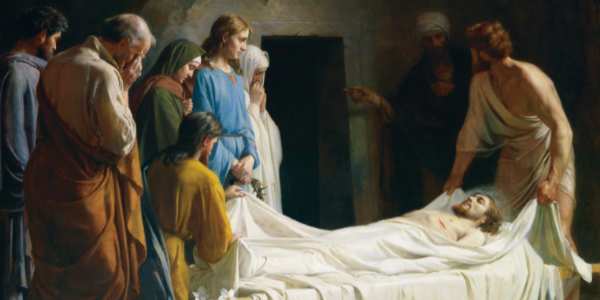
46 So Joseph bought some linen cloth, took down the body, wrapped it in the linen, and placed it in a tomb cut out of rock. Then he rolled a stone against the entrance of the tomb.
47 Mary Magdalene and Mary the mother of Joses saw where he was laid.
On verses 42-43: According to scholars, usually crucified criminals were not buried. Rather their bodies were left to rot on the cross. However, in Jewish culture, giving a dead person a proper burial was the right thing to do.
Notice it wasn’t Jesus’ family or Jesus’ disciples who buried Jesus’ body. Where were they anyway? Most of them were still hiding in fear. But where fear leaves a gap, courage comes in and fills it. Enter Joseph of Arimathea. Joseph of Arimathea boldly asks Pontius Pilate for Jesus’ body and arranges for Jesus’ burial.
Who was Joseph of Arimathea? Joseph was a leader in the Jewish community, a member of the Jewish council, and possibly a secret follower of Jesus. Given the apparent distance between him and Jesus, no one would have ever guessed that Joseph of Arimathea would be the one to bury Jesus. And yet God used Joseph of Arimathea to do just that.
Keep in mind that Jesus probably lost his father, also named Joseph, early on in life. It’s probably for that reason that his father does not appear in the gospels when Jesus starts his public ministry. To me it’s touching to think that when Jesus’ dad Joseph was not around to give his son a proper burial, another man, also called Joseph, steps up to the plate and stands in the gap for Jesus.
Joseph takes Jesus’ body and in accordance with Jewish burial customs, wraps his body in 75-100 pounds of linens and spices and places the body in a tomb. A stone is rolled in front of the tomb and, according to Matthew 27, Pilate put a Roman seal on the tomb and posted a guard to make sure that no one tampered with Jesus’ tomb.
What can we learn from this?
1. Any argument that Jesus did not die on the cross but rather “swooned” or “fainted” should be put to rest when you consider not only what Jesus endured before the cross and on the cross, but even in burial. Consider that Jesus was sentenced by the Roman government to die. If there is anything the Roman government was good at doing, it was killing people! His executioners were professional killers under official orders to make sure Jesus died. In addition to Jesus being flogged and crucified, a spear was thrust into Jesus’ side, likely puncturing his heart, bringing a flow of blood and serum, to confirm his death. Whereas executioners would normally break the crucified person’s legs to speed their death, in this case they did not need to because they confirmed that Jesus had already died. After being tortured and taken down from the cross, Jesus was then wrapped in 75-100 pounds of linens and spices, unable to move, with little air, with no medical attention, no water or food, and placed in a tomb by himself for 3 days. How plausible is it that Jesus could then recover, move the stone in front of his tomb and overcome guards all by himself? Thus the theory that “maybe Jesus didn’t really die and just passed out” is wishful thinking. Jesus died and was buried. In dying on our behalf, Jesus stood in the gap for us, making possible the forgiveness of our sins and bridging the impassable divide that stood between us and God.
2. You might not feel like you’re the closest to Jesus. Like Joseph of Arimathea, on paper you might not seem like the first choice to serve Jesus. But as long as you are willing to use what you have to serve Jesus and bold enough to respond when an opportunity arises, God can use your life to make a significant difference to serve Christ and his body, the church.
3. Where fear leaves a gap, courage comes in and fills it. When someone needed to die for our sin, Jesus stood in the gap for us. When Jesus needed someone to bury him, Joseph of Arimathea stood in the gap for Jesus. Like Jesus, and like Joseph of Arimathea, who is someone you can stand in the gap for today? You can stand in the gap for them by praying for them and reaching out to them. Do it today!
Lord Jesus, thank You so much for standing in the gap when I needed a Saviour. Thank You also for every person who has ever stood in the gap for me when I needed someone. Like Joseph of Arimathea, I pray I would courageously stand in the gap for someone today and use what I have to serve You and Your body, the church. In Jesus’ name, AMEN!
copyright © 2022 Justin Lim. All rights reserved.