Acts 21:26-40 Click here for Bible Verses
Hi GAMErs!
Today’s passage is Acts 21:26-40. Let’s go!
Acts 21:26-36 (NIV)
26 The next day Paul took the men and purified himself along with them. Then he went to the temple to give notice of the date when the days of purification would end and the offering would be made for each of them.
27 When the seven days were nearly over, some Jews from the province of Asia saw Paul at the temple. They stirred up the whole crowd and seized him,
28 shouting, “Men of Israel, help us! This is the man who teaches all men everywhere against our people and our law and this place. And besides, he has brought Greeks into the temple area and defiled this holy place.”
29 (They had previously seen Trophimus the Ephesian in the city with Paul and assumed that Paul had brought him into the temple area.)
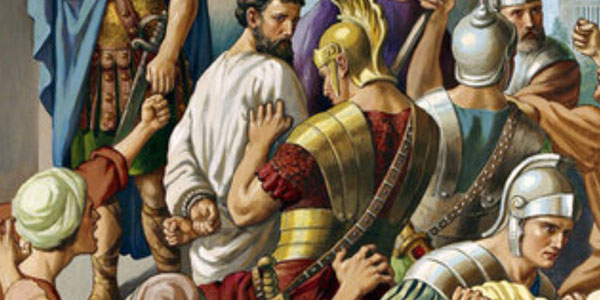
30 The whole city was aroused, and the people came running from all directions. Seizing Paul, they dragged him from the temple, and immediately the gates were shut.
31 While they were trying to kill him, news reached the commander of the Roman troops that the whole city of Jerusalem was in an uproar.
32 He at once took some officers and soldiers and ran down to the crowd. When the rioters saw the commander and his soldiers, they stopped beating Paul.
33 The commander came up and arrested him and ordered him to be bound with two chains. Then he asked who he was and what he had done.
34 Some in the crowd shouted one thing and some another, and since the commander could not get at the truth because of the uproar, he ordered that Paul be taken into the barracks.
35 When Paul reached the steps, the violence of the mob was so great he had to be carried by the soldiers.
36 The crowd that followed kept shouting, “Away with him!”
On verses 26-36: Now we see why it was such a dangerous and risky idea for Paul to go to Jerusalem, and why others tried to discourage him from going. Paul was a wanted man in Jerusalem, with many people bent on taking his life. The violent opposition Paul faced in Jerusalem is reminiscent of what Jesus faced in Jerusalem. Both Jesus and Paul knew that danger awaited them in Jerusalem. In Luke 13, when people tried to discourage Jesus from going to Jerusalem, Jesus himself said, “In any case, I must keep going today and tomorrow and the next day–for surely no prophet can die outside Jerusalem!” (Luke 13:33). Jesus even laments over the people of Jerusalem in the next verses when he says:
34 “O Jerusalem, Jerusalem, you who kill the prophets and stone those sent to you, how often I have longed to gather your children together, as a hen gathers her chicks under her wings, but you were not willing!
35 Look, your house is left to you desolate. I tell you, you will not see me again until you say, ‘Blessed is he who comes in the name of the Lord.'”
According to Jesus, Jerusalem had a history of wanting to kill the very prophets that God had sent to speak to them, and now Paul is the next in line. Yet, as we will see in the verses that follow, Paul will be delivered from the hands of those who wanted to kill him in Jerusalem. Less than 20 years later, in 70 AD, Jerusalem itself would be destroyed in the siege led by Emperor Titus.
What can we learn from this? God watches how we respond to those He has sent to give us His message. If we reject God’s messengers and their message, we too will eventually be rejected ourselves. If we seek to destroy God’s messengers and their message, we too will eventually be destroyed. But if we will humble ourselves and submit to the message God has for us, we will find peace and salvation.
Acts 21:37-40 (NIV)
37 As the soldiers were about to take Paul into the barracks, he asked the commander, “May I say something to you?” “Do you speak Greek?” he replied.
38 “Aren’t you the Egyptian who started a revolt and led four thousand terrorists out into the desert some time ago?”
39 Paul answered, “I am a Jew, from Tarsus in Cilicia, a citizen of no ordinary city. Please let me speak to the people.”
40 Having received the commander’s permission, Paul stood on the steps and motioned to the crowd. When they were all silent, he said to them in Aramaic:
On verses 37-40: The Roman commander is trying to get to the bottom of all this commotion and wants to find out who Paul is (v33). Since he can’t have a productive conversation with Paul amid all the violence and commotion outside, the Roman commander takes Paul into the barracks to be questioned. The Roman commander originally thought that Paul was an Egyptian revolutionary who led 4,000 terrorists out into the desert. But in conversing with Paul, the Roman commander learns the first important thing about Paul: that Paul is a Jew who is not from Jerusalem but from the Greek city of Tarsus. Knowing this, the Roman commander lets Paul address the crowd of Jews.
In these verses and in the next chapters that follow, we’re going to see that who Paul is – his status, his background, his heritage, his citizenship – will play an important role in why Paul is not killed in Jerusalem and why Paul is allowed to speak to certain audiences.
What can we learn from this? Sometimes God will give us a platform to speak to others that has nothing to do with our accomplishments, but simply because of our background (where we were born, where we grew up, the language we speak, the cultures we relate to). In Paul’s case, he was able to relate to the Roman commander because he spoke Greek and was born in a Greek city. At the same time Paul was also able to relate to the Jews in Jerusalem because he himself was a Jew who grew up in Jerusalem and also spoke Aramaic.
Likewise, you have a special ability to relate to people from your own country, language or culture in a way that Christians from another country, culture or language cannot. There’s an automatic credibility or approachability that can come with that.
Considering your background, your age, your citizenship, your culture, and the languages you speak, who are people that you are naturally most able to relate to? This could be a clue into the way God wants to use you and the kind of people God wants to use you to reach. For the way God wired you hints at the way God wants to use you.
Holy Spirit, I pray that I would not resist You but be like soft, mouldable clay in Your hands. Thank You for the way You formed and shaped me so that I could reach certain types of people in this world. Please help me to appreciate the way You shaped me so that I can use that shape to make the greatest impact that I can for Your glory. In Jesus’ name, AMEN!