Genesis 47:1-31Click here for Bible Verses
Hi GAMErs,
Today’s passage is Genesis 47:1-31. Let’s go!
Genesis 47:13-22 (NIV)
13 There was no food, however, in the whole region because the famine was severe; both Egypt and Canaan wasted away because of the famine.
14 Joseph collected all the money that was to be found in Egypt and Canaan in payment for the grain they were buying, and he brought it to Pharaoh’s palace.
15 When the money of the people of Egypt and Canaan was gone, all Egypt came to Joseph and said, “Give us food. Why should we die before your eyes? Our money is used up.”
16 “Then bring your livestock,” said Joseph. “I will sell you food in exchange for your livestock, since your money is gone.”
17 So they brought their livestock to Joseph, and he gave them food in exchange for their horses, their sheep and goats, their cattle and donkeys. And he brought them through that year with food in exchange for all their livestock.
18 When that year was over, they came to him the following year and said, “We cannot hide from our lord the fact that since our money is gone and our livestock belongs to you, there is nothing left for our lord except our bodies and our land.
19 Why should we perish before your eyes–we and our land as well? Buy us and our land in exchange for food, and we with our land will be in bondage to Pharaoh. Give us seed so that we may live and not die, and that the land may not become desolate.”
20 So Joseph bought all the land in Egypt for Pharaoh. The Egyptians, one and all, sold their fields, because the famine was too severe for them. The land became Pharaoh’s,
21 and Joseph reduced the people to servitude, from one end of Egypt to the other.
22 However, he did not buy the land of the priests, because they received a regular allotment from Pharaoh and had food enough from the allotment Pharaoh gave them. That is why they did not sell their land.
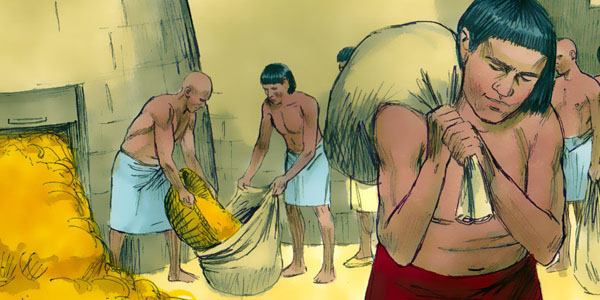
On verses 13-22: The famine in Egypt and Canaan is severe. On behalf of the Egyptian government, Joseph first sells grain to the Egyptians in exchange for their money. But when the Egyptians have no more money to give, Joseph agrees to give the Egyptians grain in exchange for their livestock. When the Egyptians have no more livestock to give, Joseph agrees to give the Egyptians grain in exchange for their real estate. When the Egyptians’ real estate had all been transferred to the government, the Egyptians still had a need for grain, so Joseph agrees to hire the Egyptians as workers for the Egyptian government. He gives the Egyptians grain to plant in the ground and allows them to keep 80% of the harvest while giving 20% back to the Egyptian government. Only the land of the priests was not touched, since the priests received a regular allotment from Pharaoh.
Notice that the Egyptians’ material possessions – their money, livestock, and land – could not buy them all the grain that they needed. Even after all their money, livestock and land had been used up, the Egyptians still had a need for more grain.
What can we learn from this?
First, the Bible describes that all of us are in need not just of physical grains, but “food that endures to eternal life” (John 6:27). What we need more than anything else is bread from heaven, which is Jesus Himself. Without the bread of God that is Jesus (see John 6:33), we would starve to death. For there is a God-sized hunger in our lives that only Jesus can fill.
Second, there is no amount of money or material possessions that we could give to buy the grain – i.e. the heavenly bread – that we need. For while we long for God and need God, we do not have sufficient means to pay off the debt of sin which we owed to God. As Psalm 49:7-9 says:
7 No man can redeem the life of another or give to God a ransom for him–
8 the ransom for a life is costly, no payment is ever enough–
9 that he should live on forever and not see decay.
But the good news is that Jesus came with riches that we do not have – the riches of a completely righteous life. Jesus used the riches of His righteousness to pay off our debt by dying on the cross for our sins. Thus, when we place our trust in what Jesus Christ has done, our sins are forgiven and the longing in our hearts for God is filled. We become priests in God’s kingdom who, like the priests of Egypt, have a protected and sufficient allotment from our King.
Praise God! What our money and material possessions could not buy, Jesus bought with His own blood, with the riches of His righteousness. When there was nothing in our possession that could sufficiently pay for the priceless bread of life that we need, God in His love gave us this bread anyway.
Genesis 47:23-26 (NIV)
23 Joseph said to the people, “Now that I have bought you and your land today for Pharaoh, here is seed for you so you can plant the ground.
24 But when the crop comes in, give a fifth of it to Pharaoh. The other four-fifths you may keep as seed for the fields and as food for yourselves and your households and your children.”
25 “You have saved our lives,” they said. “May we find favor in the eyes of our lord; we will be in bondage to Pharaoh.”
26 So Joseph established it as a law concerning land in Egypt–still in force today–that a fifth of the produce belongs to Pharaoh. It was only the land of the priests that did not become Pharaoh’s.
On verses 23-26: Notice that by verse 23 all the land now belongs to the king of Egypt. Joseph, on behalf of the king, gives the Egyptians seed to plant in the ground, letting them keep 80% of what grows while giving back 20% to the king. Let this be a reminder that, similarly, all that we have in our possession actually belongs to God our King. God is gracious in that even though He owns it all, He lets us use so much of it for our needs and only requires that we give him back a portion – in this case 10% (a tithe), which is even more generous than the 20% Joseph required! Let it be a reminder that all that we think we own is really on loan from God, and that God our King is a gracious provider who not only provides for our needs but who makes us fruitful so that we have something to give back to the King as well.
Genesis 47:27-31 (NIV)
27 Now the Israelites settled in Egypt in the region of Goshen. They acquired property there and were fruitful and increased greatly in number.
28 Jacob lived in Egypt seventeen years, and the years of his life were a hundred and forty-seven.
29 When the time drew near for Israel to die, he called for his son Joseph and said to him, “If I have found favor in your eyes, put your hand under my thigh and promise that you will show me kindness and faithfulness. Do not bury me in Egypt,
30 but when I rest with my fathers, carry me out of Egypt and bury me where they are buried.” “I will do as you say,” he said.
31 “Swear to me,” he said. Then Joseph swore to him, and Israel worshiped as he leaned on the top of his staff.
On verses 27-31: To think that Jacob spent almost as much time (17 years) as the 20 years he spent in Paddam Aram decades before working for his uncle Laban and accumulating the wealth that he did (Genesis 31:38). Yet despite his children – including his long lost son Joseph – and grandchildren living there in Egypt with him, Jacob never forgot where he was meant to be in the end: to be buried with his father Isaac and grandfather Abraham in Canaan. That is why as Jacob nears his death, Jacob makes Joseph swear an oath. Using the customary way of giving oaths, Jacob makes Joseph promise to carry Jacob out of Egypt and bury him in Canaan. After Joseph gives his oath, faith-fueled Jacob (once again called Israel in verse 31) worships as he leans on his staff.
What can we learn from this? May you never forget where you ultimately belong. You may find yourself living in different places, working in different environments, but may you always remember that you are a citizen of heaven (Philippians 3:20). Remember that you are someone who is in the world but not of the world, and that your final destination is not here on earth, but in heaven with Jesus. That is why Peter calls us “aliens and strangers” in this world (1 Peter 2:11). May that attitude colour and empower the way you live life in this world. May you not cling too tightly to the things of this earth, and may you not get too comfortable here as if earth is where you’ll stay, but may you keep your heart on heaven and your eyes on the mission and calling God has for you.
Heavenly Father, thank You that even when I could not afford it, in Your love You gave me what I needed the most: bread of life. His name is Jesus. Today I am reminded that all that I possess belongs to You and that I am only a trustee and a steward of what You have entrusted to me. Thank You for reminding me today that my citizenship is in heaven, and so may I live these days on earth knowing that I’m not meant to stay here, but I’m going home one day. In Jesus’ name, AMEN!