Genesis 48:1-22Click here for Bible Verses
Hi GAMErs,
Today’s passage is Genesis 48:1-22. Let’s go!
Genesis 48:1-6 (NIV)
1 Some time later Joseph was told, “Your father is ill.” So he took his two sons Manasseh and Ephraim along with him.
2 When Jacob was told, “Your son Joseph has come to you,” Israel rallied his strength and sat up on the bed.
3 Jacob said to Joseph, “God Almighty appeared to me at Luz in the land of Canaan, and there he blessed me
4 and said to me, ‘I am going to make you fruitful and will increase your numbers. I will make you a community of peoples, and I will give this land as an everlasting possession to your descendants after you.’
5 “Now then, your two sons born to you in Egypt before I came to you here will be reckoned as mine; Ephraim and Manasseh will be mine, just as Reuben and Simeon are mine.
6 Any children born to you after them will be yours; in the territory they inherit they will be reckoned under the names of their brothers.
On verses 1-6: Jacob, nearing his death, gets ready to bless the generations that have come after him. He decides to begin with Joseph and Joseph’s sons. What does Jacob mean when he says that Joseph’s sons Ephraim and Manasseh will be reckoned as his own “just as Reuben and Simeon are mine” (v5)? Jacob means that for inheritance purposes he will treat Ephraim and Manasseh as belonging to the same generation as Jacob’s own sons, meaning that Ephraim and Manasseh would each get the same kind of inheritance that their uncles would get. The effect of this decision was two-fold:
– First, Jacob was elevating the status of Ephraim and Manasseh to the same level as their uncles. That is why when we read about the later history of Israel in the Old Testament, along with the other tribes of Simeon, Judah, Levi, and other sons of Jacob, we don’t hear so much about the tribe of Joseph but we do hear often about a tribe of Ephraim and a tribe of Manasseh.
– Second, Jacob was effectively giving Joseph’s family a double inheritance compared to all the rest of Jacob’s sons. Even though Joseph was the second youngest of Jacob’s sons, Jacob was treating Joseph like his firstborn, giving him a double inheritance, even though Reuben was technically the oldest son and Jaco’s firstborn (see 1 Chronicles 5:1-2).
Just as Jacob elevated the status of Ephraim and Manasseh and gave them each an inheritance as if they were direct sons of Jacob, so your Heavenly Father elevated our status even more. From sinners who were disqualified from having any inheritance, we became children of God with an inheritance equal to that of God’s Son Jesus (1 Peter 1:3-4; Colossians 1:12; Ephesians 1:14), all because of God’s mercy and grace.
Genesis 48:7-12 (NIV)
7 As I was returning from Paddan, to my sorrow Rachel died in the land of Canaan while we were still on the way, a little distance from Ephrath. So I buried her there beside the road to Ephrath” (that is, Bethlehem).
8 When Israel saw the sons of Joseph, he asked, “Who are these?”
9 “They are the sons God has given me here,” Joseph said to his father. Then Israel said, “Bring them to me so I may bless them.”
10 Now Israel’s eyes were failing because of old age, and he could hardly see. So Joseph brought his sons close to him, and his father kissed them and embraced them.
11 Israel said to Joseph, “I never expected to see your face again, and now God has allowed me to see your children too.”
12 Then Joseph removed them from Israel’s knees and bowed down with his face to the ground.
On verses 7-12: Jacob, who is once again called Israel here, intends to bless Joseph’s sons Ephraim and Manasseh. He mentions in verse 7 that he lost his wife Rachel unexpectedly.
In verse 11, Jacob mentions how he never expected to see Joseph’s face again, and now he gets to see Joseph’s children as well. It goes to show that life is full of unexpected pain as well as unexpected blessings. But through all the joy and the pain, God is writing a greater story with our lives than anything we could write for ourselves.
Genesis 48:13-20 (NIV)
13 And Joseph took both of them, Ephraim on his right toward Israel’s left hand and Manasseh on his left toward Israel’s right hand, and brought them close to him.
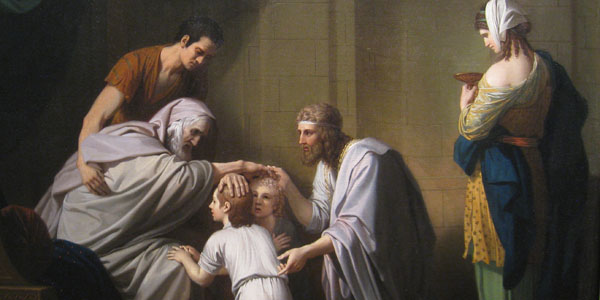
14 But Israel reached out his right hand and put it on Ephraim’s head, though he was the younger, and crossing his arms, he put his left hand on Manasseh’s head, even though Manasseh was the firstborn.
15 Then he blessed Joseph and said, “May the God before whom my fathers Abraham and Isaac walked, the God who has been my shepherd all my life to this day,
16 the Angel who has delivered me from all harm –may he bless these boys. May they be called by my name and the names of my fathers Abraham and Isaac, and may they increase greatly upon the earth.”
17 When Joseph saw his father placing his right hand on Ephraim’s head he was displeased; so he took hold of his father’s hand to move it from Ephraim’s head to Manasseh’s head.
18 Joseph said to him, “No, my father, this one is the firstborn; put your right hand on his head.”
19 But his father refused and said, “I know, my son, I know. He too will become a people, and he too will become great. Nevertheless, his younger brother will be greater than he, and his descendants will become a group of nations.”
20 He blessed them that day and said, “In your name will Israel pronounce this blessing: ‘May God make you like Ephraim and Manasseh.'” So he put Ephraim ahead of Manasseh.
On verses 13-20: The fact that Jacob’s eyes are failing (v10) and he can hardly recognize Ephraim and Manasseh recalls the time when Jacob’s father Isaac, with failing eyes, is about to give his blessing to what he thinks is his firstborn Esau (Genesis 27:1). In that earlier case, Isaac would accidentally bless Jacob, thinking mistakenly that he was blessing his firstborn Esau (Genesis 27). In this present case, however, Jacob is very clear about whom he is going to give the greater blessing to between Joseph’s two sons Ephraim and Manasseh.
Just as Jacob the younger son got his father’s blessing over Esau his older brother, and just as Jacob gave Joseph one of his youngest sons a greater blessing than he gave his older sons, here we see Jacob continuing a similar trend as he blesses his grandchildren, Ephraim and Manasseh, Joseph’s sons, in a similar way. Instead of putting his right hand (representing the highest favour and blessing a father can give) on the firstborn Manasseh and his left hand on Ephraim, Jacob crosses his arms and puts his right hand on the younger Ephraim and his left hand on the older Manasseh. Even when Joseph protests this move, Jacob insists on pronouncing a greater blessing on the younger Ephraim. Why? Was Jacob just continuing a generational trend? Was Jacob partial to blessing the younger sibling since he himself was a younger sibling? It wasn’t only because of preference or tradition, but because of God’s sovereign choice. Apparently Jacob had previously received a word from God about the future of these two young boys, about how both of them would be great nations but that Ephraim would have more descendants and thus be “greater” than his brother Manasseh (see Numbers 2:18-21 and Deuteronomy 33:17). Thus in faith Jacob goes with this word and blesses Ephraim and Manasseh accordingly.
What can we learn from all this? God is sovereign. God decides as God wants to decide and no one can sway God differently. If God wants to bless the younger especially, the younger will be especially blessed. God has total freedom, authority and right to decide who He will bless and how much.
Genesis 48:21 (NIV)
21 Then Israel said to Joseph, “I am about to die, but God will be with you and take you back to the land of your fathers.
On verse 21: Though your closest loved ones will not always be with you, God will always be with you and will be faithful to bring you home to where you belong.
Genesis 48:22 (NIV)
22 And to you, as one who is over your brothers, I give the ridge of land I took from the Amorites with my sword and my bow.”
On verse 22: To show how much he favoured Joseph, Jacob once gave Joseph a colorful robe. Now Jacob gives Joseph a ridge of land that Jacob himself conquered. Jacob gave the things dearest to his heart, the things he worked the hardest to gain, to his most favoured son. Similarly, because He loves you, your Heavenly Father has given you the things dearest to His heart, the things He worked the hardest to gain – namely, our salvation, our forgiveness, our redemption which were all made possible only by Christ’s death on the cross. He does that because You are dearest to Him.
Heavenly Father, You are sovereign in all the decisions You make. Thank You that in Your sovereignty You decided to bless me with the highest favour and blessing You could give, even when I didn’t naturally deserve it. Thank You that through all the unexpected joys and pains we experience in life, You are writing a greater story than anything we could write. In Jesus’ name, AMEN!