Isaiah 14:1-27 Click here for Bible Verses
Hi GAMErs!
Today’s passage is Isaiah 14:1-27. Let’s go!
Isaiah 14:1-11 (NIV)
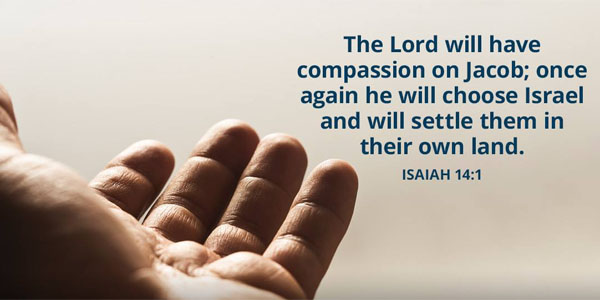
1 The LORD will have compassion on Jacob; once again he will choose Israel and will settle them in their own land. Aliens will join them and unite with the house of Jacob.
2 Nations will take them and bring them to their own place. And the house of Israel will possess the nations as menservants and maidservants in the LORD’s land. They will make captives of their captors and rule over their oppressors.
3 On the day the LORD gives you relief from suffering and turmoil and cruel bondage,
4 you will take up this taunt against the king of Babylon: How the oppressor has come to an end! How his fury has ended!
5 The LORD has broken the rod of the wicked, the scepter of the rulers,
6 which in anger struck down peoples with unceasing blows, and in fury subdued nations with relentless aggression.
7 All the lands are at rest and at peace; they break into singing.
8 Even the pine trees and the cedars of Lebanon exult over you and say, “Now that you have been laid low, no woodsman comes to cut us down.”
9 The grave below is all astir to meet you at your coming; it rouses the spirits of the departed to greet you– all those who were leaders in the world; it makes them rise from their thrones– all those who were kings over the nations.
10 They will all respond, they will say to you, “You also have become weak, as we are; you have become like us.”
11 All your pomp has been brought down to the grave, along with the noise of your harps; maggots are spread out beneath you and worms cover you.
On verses 1-11: I know these verses are technically part of Isaiah’s oracle against Babylon that started in the previous chapter. But when I read these verses from Isaiah 14, I can’t help but think about how well these verses describe what God did for us through Jesus Christ: how God, through Jesus Christ, set us free from the burden of the “king of Babylon”, from Satan the king of false religion who once held us captive (v4). In fact, the entire Isaiah 14 seems to speak in much bigger, more cosmic, more spiritual terms than just talking about the fall of one ancient kingdom.
Just as many Bible scholars have concluded in the past, I would submit that the best way to read Isaiah 14 is not only as a description of how God would rescue the people of Judah and Israel from the ancient empire of Babylon. Even more it is also a picture of what Jesus Christ has done for us: how through Jesus Christ we are chosen by God (v1), settled in a land of our own called heaven (v1), united with believers from other nations (v1), made rulers in God’s kingdom (v2), declared victorious over our captors (v2), given relief from suffering, turmoil and harsh labor (v3), and how through Jesus’ death and resurrection God has brought our oppressor to an end (v4) and broken our enemy’s scepter (v5). As a result, we can be “at rest and at peace” (v7), we can sing for joy (v7). Even those of us who were cut down in this life can gloat over our enemy in the long term (v8) while Satan is ushered into his final and inglorious fate (v9-11). In other words, what Isaiah saw here in the abstract, we get to experience in reality, both partially today and fully later, all because of Jesus.
Isaiah 14:12-23 (NIV)
12 How you have fallen from heaven, O morning star, son of the dawn! You have been cast down to the earth, you who once laid low the nations!
13 You said in your heart, “I will ascend to heaven; I will raise my throne above the stars of God; I will sit enthroned on the mount of assembly, on the utmost heights of the sacred mountain.
14 I will ascend above the tops of the clouds; I will make myself like the Most High.”
15 But you are brought down to the grave, to the depths of the pit.
16 Those who see you stare at you, they ponder your fate: “Is this the man who shook the earth and made kingdoms tremble,
17 the man who made the world a desert, who overthrew its cities and would not let his captives go home?”
18 All the kings of the nations lie in state, each in his own tomb.
19 But you are cast out of your tomb like a rejected branch; you are covered with the slain, with those pierced by the sword, those who descend to the stones of the pit. Like a corpse trampled underfoot,
20 you will not join them in burial, for you have destroyed your land and killed your people. The offspring of the wicked will never be mentioned again.
21 Prepare a place to slaughter his sons for the sins of their forefathers; they are not to rise to inherit the land and cover the earth with their cities.
22 “I will rise up against them,” declares the LORD Almighty. “I will cut off from Babylon her name and survivors, her offspring and descendants,” declares the LORD.
23 “I will turn her into a place for owls and into swampland; I will sweep her with the broom of destruction,” declares the LORD Almighty.
On verses 12-23: Here Isaiah talks about the fall of the king of Babylon, how the king of Babylon thought he could be God and how pride led to his downfall. Keeping with the idea that Isaiah 14 is speaking in much bigger, more cosmic terms than just talking about the fall of ancient Babylon, it is not hard to see why Isaiah 14 is often taken to describe the fall of Satan, the ultimate king of “Babylon”, the originator of false religion. Satan thought he could be like God (v14) and even greater than God (“I will raise my throne above the stars of God” – v13). He has deceived countless others across history into thinking they too could ascend to heaven by their own power. But through Jesus’ death and resurrection, this king of Babylon has been defeated, “brought down to the grave, to the depths of the pit” (v15).
Once so powerful, the king of Babylon is described now as “a rejected branch” (v19), unlike the fruitful Branch that the Messiah would become (Isaiah 9:1). The king of Babylon is described as being covered in dead corpses (v19) and the kingdom he built destroyed (v22-23). That is ultimately Satan’s fate. Jesus stands victorious.
What can we learn from this? It’s one of history’s oldest lessons: Pride goes before the fall. It happened to Satan. It can happen to us too if we are not careful. Always keep a humble attitude. Realize that it’s not about us but about God’s glory and kingdom.
Isaiah 14:24-27 (NIV)
24 The LORD Almighty has sworn, “Surely, as I have planned, so it will be, and as I have purposed, so it will stand.
25 I will crush the Assyrian in my land; on my mountains I will trample him down. His yoke will be taken from my people, and his burden removed from their shoulders.”
26 This is the plan determined for the whole world; this is the hand stretched out over all nations.
27 For the LORD Almighty has purposed, and who can thwart him? His hand is stretched out, and who can turn it back?
On verses 24-27: At the back end of this message against Babylon, Isaiah includes a message about Assyria. At this time Assyria was the dominant threat in the region, the one that Judah was most scared of. Yet here the LORD says that He will crush the Assyrian “in my land; on my mountains I will trample him down” (v24). In other words, though Assyria tries to attack Judah on Judah’s own soil, God promises that Assyria will not succeed and that one day the burden that Assyria has caused Judah will be lifted.
What can we learn from these verses? The biggest lesson coming out of these verses is that God is sovereign. Whatever God decides will happen. “Surely, as I have planned, so it will be, and as I have purposed, so it will stand…For the LORD Almighty has purposed, and who can thwart him? His hand is stretched out, and who can turn it back?” (v24, 27)
Praise God that it was His sovereign choice to crush our oppressor Satan and to break our enemy’s yoke from our necks. God did this by sending Jesus Christ to rescue us.
Thank You Father that through Jesus Christ You have broken the yoke of Babylon that once held us down. Since pride goes before the fall, may I always keep a humble attitude before You and before people. In Jesus’ name, AMEN!