James 3:13-18 Click here for Bible Verses
Hi GAMErs,
Today’s passage is James 3:13-18. Let’s go!
James 3:13a (NIV)
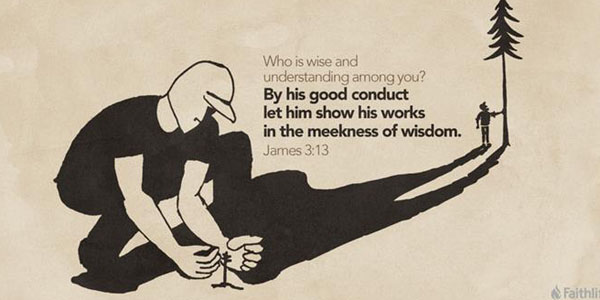
13 Who is wise and understanding among you? Let him show it by his good life…
On verse 13a: Earlier James told his readers to ask God for wisdom (James 1:5). Now James addresses the question: How do you know if a person is truly wise or not? Here in verse 13 we learn that wisdom is not so much shown in what facts and figures a person can recite. Rather, how much wisdom a person has is shown by the way that person lives and by the decisions that person makes. Wisdom and being book smart are not the same thing. Some people are book smart and can tell you all sorts of facts and figures, but when it comes to making life decisions, or handling relationships, time or money, they live very foolishly. God calls us to be wise and understanding in practical ways that matter the most.
James 3:13b (NIV)
13 …by deeds done in the humility that comes from wisdom.
On verse 13b: Jesus says, “wisdom is proved right by all her children” (Luke 7:35). In other words, you can tell if a person has wisdom by what that person produces. Here in verse 13 we learn that one of the most important things that wisdom produces in us is an attitude of humility. Humility is the firstborn child of wisdom. When my thoughts are prideful, arrogant, or self-centered, I know I’m moving in a direction that is opposite to wisdom.
James 3:14-17 (NIV)
14 But if you harbor bitter envy and selfish ambition in your hearts, do not boast about it or deny the truth.
15 Such “wisdom” does not come down from heaven but is earthly, unspiritual, of the devil.
16 For where you have envy and selfish ambition, there you find disorder and every evil practice.
17 But the wisdom that comes from heaven is first of all pure; then peace-loving, considerate, submissive, full of mercy and good fruit, impartial and sincere.
On verses 14-17: Most people, when making decisions, try to be wise or think they’re being wise. I don’t anyone who would honestly call themselves a fool. So how do you really know if you’re really being wise or not? James gives us some clues to help differentiate godly wisdom from worldly foolishness. If the motivation behind a decision you are considering is bitterness (you hold a grudge against someone), envy (you envy what someone else has), or selfish ambition (you live as if the world revolves around you) (v14), then the direction is not from God; it’s foolish living (v15). To continue in that direction will only result in “disorder” (i.e. misery, priorities being out of place, unhealthy relationships and things being outside of the order God would place them in). It will also result in “every evil practice”, where you do things that are wrong because you think you have no choice (v16). Such “wisdom” is no wisdom at all.
In contrast, a decision is wise when it is characterized by peace, purity, consideration of others, submissiveness to God, mercy toward others, impartiality instead of favoritism, authenticity and other good fruit (v17). The next time you are making an important decision, run it by these verses to help you determine whether you are heading in wisdom’s ways or not.
James 3:18 (NIV)
18 Peacemakers who sow in peace raise a harvest of righteousness.
On verse 18: There is a relationship between peace and righteousness. For example, Psalm 85:10 says, “righteousness and peace kiss each other”. One thing I’ve learned is that righteousness results in peace. When I do the right thing, my conscience is at peace. Jesus came to give us peace by living a righteous life that met all of God’s requirements. His righteousness results in our peace.
Now while righteousness does result in peace, verse 18 is talking about the reverse process where somehow peace produces righteousness. What exactly does it mean for “peacemakers to sow in peace” and how does that create a “harvest of righteousness”? Here’s how I understand it: righteousness is really Christ-likeness, for no one is righteous, not even one, except Jesus Christ (Romans 3:10). When I make an important decision by following the peace of God in my heart (or as David would say, when I “seek peace and pursue it” (Psalm 34:14)), the result is often a good and righteous decision that Christ Himself would make. Second, when I make peace with others and live at peace with them, the result is a righteous community where Christ’s name is honored and Christ’s presence can be felt. In these two ways, peacemakers who sow in peace raise a harvest of righteousness.
In a way verse 18 is a nice bridge between this chapter 3 and the next chapter, for in the next chapter our attention turns to how we get along in relationships.
Heavenly Father, thank You for Your Word which helps me to decipher whether the decision I am considering is truly godly wisdom, or just worldly foolishness. Thank You for showing me the relationship between peace and righteousness. May I pursue Your peace in all my decisions and relationships, so that Jesus my Righteous One who would glorified and made manifest in all that I do. In Jesus’ name, AMEN!