Joel 1:1-12 (CLICK HERE FOR BIBLE VERSES)
Hi GAMErs!
Today we begin the book of Joel. Not much is known about Joel. We do know that he was a prophet living in Jerusalem and his name means “Jehovah is his God”. His dad’s name was Pethuel meaning “vision of God”. It is not clear when the book of Joel was written. In fact, there is quite possibly no book in the Bible whose date of composition is more widely debated than the book of Joel, with various scholars proposing dates as early as approximately 900 B.C. to as late as 200 B.C. As Robert B. Chisholm, Jr. of the Bible Knowledge Commentary writes, given the lack of clear historical clues, “it is impossible to be dogmatic about the date of the writing of Joel”[1]. Though overall preferring a 7th century B.C. date, D.A. Garrett from the New American Commentary also concludes that “[a]ny suggested time frame for the book should be tentative, and the interpretation of the book should not depend upon a hypothetical historical setting.”[2] That said, Joel is a powerful book with some important lessons for us today.
Today’s passage is Joel 1:1-12. Let’s go!
Joel 1:1-12 (NIV)
1 The word of the LORD that came to Joel son of Pethuel.
2 Hear this, you elders; listen, all who live in the land. Has anything like this ever happened in your days or in the days of your forefathers?
3 Tell it to your children, and let your children tell it to their children, and their children to the next generation.
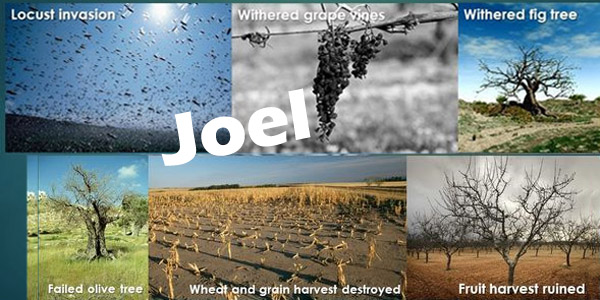
4 What the locust swarm has left the great locusts have eaten; what the great locusts have left the young locusts have eaten; what the young locusts have left other locusts have eaten.
5 Wake up, you drunkards, and weep! Wail, all you drinkers of wine; wail because of the new wine, for it has been snatched from your lips.
6 A nation has invaded my land, powerful and without number; it has the teeth of a lion, the fangs of a lioness.
7 It has laid waste my vines and ruined my fig trees. It has stripped off their bark and thrown it away, leaving their branches white.
8 Mourn like a virgin in sackcloth grieving for the husband of her youth.
9 Grain offerings and drink offerings are cut off from the house of the LORD. The priests are in mourning, those who minister before the LORD.
10 The fields are ruined, the ground is dried up; the grain is destroyed, the new wine is dried up, the oil fails.
11 Despair, you farmers, wail, you vine growers; grieve for the wheat and the barley, because the harvest of the field is destroyed.
12 The vine is dried up and the fig tree is withered; the pomegranate, the palm and the apple tree– all the trees of the field–are dried up. Surely the joy of mankind is withered away.
On verses 1-12: Here in very poetic language Joel talks about a locust plague that has ravaged his land (v4). The plague has left his people with little or no crops and vegetation. Fields are ruined (v10) and grain is destroyed (v10). Vegetation in Israel has dried up (v12) along with the joy of the nation (v12). It is a time of mourning for all the Israelites (v8), from drunkards (v5) to priests (v9) to farmers (v11).
Later on in the book of Joel, God will promise to repay the Israelites for the years that the locusts have eaten (2:25). He will promise to restore provision and joy to the people once again (2:22-24). But in the meantime, here in chapter 1 Joel leads the people in weeping, grieving and mourning their loss.
What can we learn from this? Two lessons:
1. When you encounter an especially painful, hurtful time, it’s okay to grieve. As Ecclesiastes 4:4 says, there is “a time to weep and a time to laugh, a time to mourn and a time to dance”. Give yourself the time you need to grieve when you go through tremendous loss. When you grieve in God’s presence, you give God an opportunity to work in your life.
2. Sometimes things need to get bad and then worse before things can get better and we can see God’s glory. That’s what happened in the book of Joel, and that’s what often happens in our lives as well. While none of us likes going through tough or uncertain times, it is also in our tough and uncertain times that God works His greatest miracles.
So if you’re going through a difficult season, don’t despair. Don’t think that God is not there or He doesn’t care. God is not finished with your story. He is writing a story that is greater than anything you could write for yourself. But just like any great story, heartbreak, grief, disappointment, defeat, loss and failure often come before the hope, the lesson and the final victory. So when things go from bad to worse, remember: God is not finished writing your story. The best is yet to come.
Father, thank You that You are not finished with my story. Thank You in all things You work for the good of those who love You. Thank You that every hurt, every pain, every loss and defeat are things You will use to ultimately display Your glory through my life. Thank You that because of Jesus and the hope we have in Him, the best is always yet to come. In Jesus’ name, AMEN!
Copyright © 2021 Justin Lim. All rights reserved.