
Zeb Wilson
Life Starts From a “Simple” Cell — But That Cell Is More Complex Than Any Machine,
We are often told that life began with a simple cell.
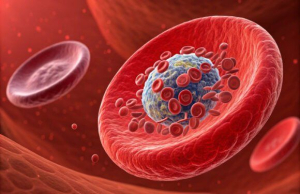
But when biology actually examines that cell, “simple” quickly becomes a misleading word.
A single living cell is not a blob of chemicals. It is a fully integrated system—more sophisticated than any machine humans have ever designed.
Inside one cell:
- Millions of molecular machines work in coordination—motors, pumps, switches, and factories operating at the nanometer scale
- DNA stores vast amounts of digital information, using a precise chemical code that must be read, copied, and corrected
- Error-correction systems constantly monitor and repair mistakes, similar to — and in many cases exceeding — modern computer systems
- Energy production units convert raw materials into usable power (ATP) with extraordinary efficiency
- Self-repair, self-regulation, and self-replication occur automatically, without external control
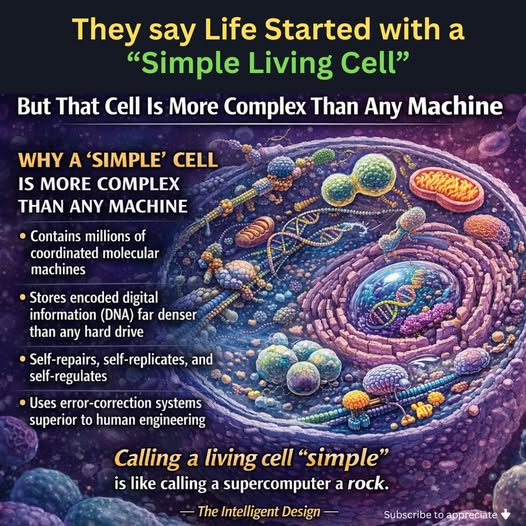
Human machines do one or two of these things—never all of them at once, and never autonomously.
Even the most advanced technology on Earth:
- Cannot self-replicate from raw materials
- Cannot self-repair at the molecular level
- Cannot generate new coded instructions without intelligent input
Yet a living cell does all of this continuously.
Calling a living cell “simple” is like calling a supercomputer a rock.

This raises a serious question:
If every complex, information-rich system we know comes from intelligence…
why should the most advanced system we’ve ever discovered be the lone exception?
This isn’t a religious claim.
It’s a design inference—the same type of reasoning used in engineering, archaeology, and information science.
The deeper we look into life, the more we find precision, coordination, and purpose at every level.
And that’s why the idea of a “simple” starting cell doesn’t solve the mystery of life’s origin—
it deepens it.
— The Intelligent Design