
Deuteronomy 1:34-46 Click here for Bible Verses
Hi GAMErs!
Today’s passage is Deuteronomy 1:34-46.
Deuteronomy 1:34-36 (NIV)
34 When the LORD heard what you said, he was angry and solemnly swore:
35 “Not a man of this evil generation shall see the good land I swore to give your forefathers,
36 except Caleb son of Jephunneh. He will see it, and I will give him and his descendants the land he set his feet on, because he followed the LORD wholeheartedly.”
On verses 34-36: Caleb’s story shows us that just because the people around you are not responding to God with faith, that doesn’t mean you have to follow their lead. Like Caleb you can choose a unique path of responding to God with faith, even when those around you are not. Dare to be different in a good way, and you will be uniquely blessed in the process.
Caleb’s story also shows us that when we follow God wholeheartedly, not only are we blessed, but those who come after us will be blessed as well. There’s a generational blessing that comes when a person decides to respond to God in faith.
Deuteronomy 1:37-46 (NIV)
37 Because of you the LORD became angry with me also and said, “You shall not enter it, either.
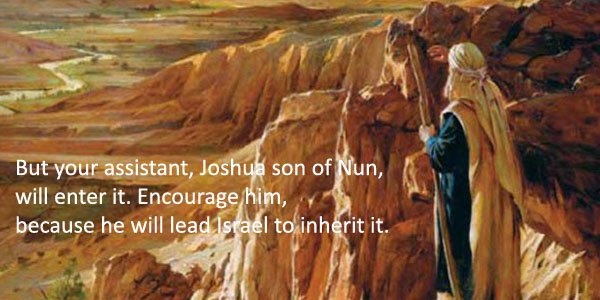
38 But your assistant, Joshua son of Nun, will enter it. Encourage him, because he will lead Israel to inherit it.
39 And the little ones that you said would be taken captive, your children who do not yet know good from bad–they will enter the land. I will give it to them and they will take possession of it.
40 But as for you, turn around and set out toward the desert along the route to the Red Sea.” 41 Then you replied, “We have sinned against the LORD. We will go up and fight, as the LORD our God commanded us.” So every one of you put on his weapons, thinking it easy to go up into the hill country.
42 But the LORD said to me, “Tell them, ‘Do not go up and fight, because I will not be with you. You will be defeated by your enemies.'”
43 So I told you, but you would not listen. You rebelled against the LORD’s command and in your arrogance you marched up into the hill country.
44 The Amorites who lived in those hills came out against you; they chased you like a swarm of bees and beat you down from Seir all the way to Hormah.
45 You came back and wept before the LORD, but he paid no attention to your weeping and turned a deaf ear to you.
46 And so you stayed in Kadesh many days–all the time you spent there.
On verses 37-46: After refusing to trust God’s leading about going to the Promised Land the first time, the Israelites refuse again to listen to God’s instructions when God tells them to turn around and set out toward the desert. While sounding very spiritual after their first mistake and saying, “We have sinned against the Lord…we will obey now” (v41), they were actually refusing to listen to do what God was now saying to them. They refused to believe what God was now saying to them, which is that if they try to go and conquer the Promised Land now, God’s blessing would not be with them and they would fail. Refusing to listen to God, the Israelites nevertheless go ahead anyway and are beaten down badly. What can we learn from this? We can sound very spiritual and humble in the words we use toward God and others, claiming that we’ve learned and grown up so much, but if our hearts are still bent on doing our own thing rather than listening to God’s specific and current instructions for our lives, then we haven’t learned anything and we’ll miss God’s biggest blessings for our lives.
Also, keep in mind that when Moses is speaking to the Israelites in Deuteronomy 1 and recounting their history in the wilderness, don’t be fooled by the fact that Moses keeps using the word “you” (e.g. “you did this” and “you didn’t do that”). Actually, the people Moses is talking to in Deuteronomy 1 are the current generation of Israelites, many of whom were very young or not even yet born when the events Moses describes in Deuteronomy 1 took place.
So what’s going on? Moses is talking to the current generation of Israelites about their parents’ and grandparents’ biggest mistakes, mistakes made by previous generations. He’s doing it not to put down the previous generations but so that the current generation of leaders can learn. For to prepare the current generation of Israelites to conquer the Promised Land, it was especially important for Moses to tell the current generation of Israelites how the previous generation of Israelites responded poorly to similar challenges. That way the current generation would not repeat the mistakes of the previous generations.
What’s the lesson here? We should appreciate and thank God for the generations that came before us. We should honour them and preserve their legacy for future generations. At the same, if people in the generations before us made mistakes (and every generation makes mistakes), we must learn from them and be careful not to repeat them. It is far less painful to learn from other people’s mistakes than to learn from our own mistakes.
Also, since we have all made mistakes, may we be like Moses and not be afraid to share our mistakes and the lessons we learned from those mistakes with those coming after us.
What are some lessons you have learned from the successes and failures, victories and mistakes of the generations that came before you?
What are some lessons you have learned from your own successes, failures, victories and mistakes that are worth sharing with those coming after you?
Father, no matter what the people around me are doing, I pray that like Caleb I would follow You wholeheartedly, knowing that special blessing will follow me when I do. I also pray for wisdom to learn from the mistakes of those who went before me and for the courage and humility to share my mistakes and the lessons you taught me from my mistakes with those coming after me. In Jesus’ name, AMEN!