Deuteronomy22:1-12 Click here for Bible Verses
Hi GAMErs!
Today’s passage is Deuteronomy 22:1-12. Let’s go!
Deuteronomy 22:1-4 (NIV)
1 If you see your brother’s ox or sheep straying, do not ignore it but be sure to take it back to him.
2 If the brother does not live near you or if you do not know who he is, take it home with you and keep it until he comes looking for it. Then give it back to him.
3 Do the same if you find your brother’s donkey or his cloak or anything he loses. Do not ignore it.
4 If you see your brother’s donkey or his ox fallen on the road, do not ignore it. Help him get it to its feet.
On verses 1-4: Here Moses tells the current generation of Israelites to be good neighbours to each other, using illustrations about one Israelite losing something valuable to them. Likewise, when you come across something that your neighbour has lost, “do not ignore it” (v1, 3). Rather do for your neighbour what you would have them do for you.
Deuteronomy 22:5 (NIV)
5 A woman must not wear men’s clothing, nor a man wear women’s clothing, for the LORD your God detests anyone who does this.
On verse 5: Why does verse 5 prohibit a man from wearing women’s clothing and vice versa? It’s because clothing is an expression of a person’s identity. What you wear reflects how you see yourself. This is especially controversial in Western culture where it’s all about “be whoever you want to be”. But we must remember that God created people to be male and female for a purpose (Genesis 1:27 and 5:2, also Matthew 19:4). True lasting peace comes from understanding, accepting and embracing the way God made you.
Deuteronomy 22:6-7 (NIV)
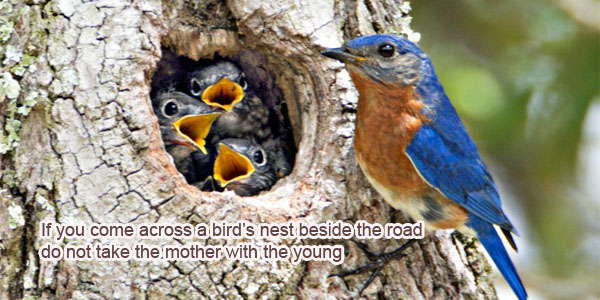
6 If you come across a bird’s nest beside the road, either in a tree or on the ground, and the mother is sitting on the young or on the eggs, do not take the mother with the young.
7 You may take the young, but be sure to let the mother go, so that it may go well with you and you may have a long life.
On verses 6-7: Why does Moses tell the Israelites to take the eggs but let the mother bird go free? It’s because the mother bird can produce more eggs in the future. In other words, use your resources wisely. Don’t just use up all you have today. Save and think about the long term too “so that it may go well with you and you may have a long life” (v7).
Deuteronomy 22:8 (NIV)
8 When you build a new house, make a parapet around your roof so that you may not bring the guilt of bloodshed on your house if someone falls from the roof.
On verse 8: Moses tells the Israelites to build a parapet, which is a protective barricade on their balconies and rooftops, so as to keep visitors safe. The lesson is similar to the message of verses 1-4: look out for your neighbour’s well being.
Deuteronomy 22:9-11 (NIV)
9 Do not plant two kinds of seed in your vineyard; if you do, not only the crops you plant but also the fruit of the vineyard will be defiled.
10 Do not plow with an ox and a donkey yoked together.
11 Do not wear clothes of wool and linen woven together.
On verses 9-11: It is not entirely clear what Moses’ reasons were for prohibiting the Israelites from planting two kinds of seed in the same field (v9), or for forbidding the Israelites from wearing clothes of wool and linen woven together (v11). As for not plowing with an oxen and a donkey yoked together, I could see that prohibition making sense given the difference in size, strength and nature between an oxen and a donkey. I could see the oxen not getting much help from the weaker, smaller donkey and having to bear most if not all of the weight of the yoke. I could also see the donkey being trampled on and struggling trying to walk side by side with the oxen.
If there is any message we are to take from these verses, it could be this general principle: just as Jesus said “whatever God has joined together, let man not separate” (Matthew 19:6), so whenever in Scripture God makes it clear that two things are to be kept separate, we must not try to join them together. For example, the New Testament warns Christians against yoking themselves romantically or otherwise to someone who doesn’t follow Jesus (see 2 Corinthians 6:14-18). As another example, don’t try to combine the plan of salvation from other religions with the plan of salvation that Christianity offers so as to create a new faith, because they simply will not mix (John 14:6). These would be two clear cases where God in Scripture tells His people not to join what He intends to keep separate. (Some scholars have tried to interpret these verses as indirect, symbolic prohibitions against committing adultery, although to conclude that adultery is specifically what Moses was trying to address with these verses seems a bit of a stretch.)
Deuteronomy 22:12 (NIV)
12 Make tassels on the four corners of the cloak you wear.
On verse 12: Why make tassels on cloaks? Tassels were a visual reminder to the Israelites that they belong to God and were to obey God’s commands (see Numbers 15:39-40). What can we learn from this? Sometimes it helps to place a visual reminder in our line of sight to remind us of who we belong to and the people God has called us to be (e.g. wearing a cross around your neck, placing verses in your car, office or room).
Father, thank You for every lesson we can learn from Your Word, even those verses which are harder for us to understand. In Jesus’ name, AMEN!