
Isaiah 13:1-22 Click here for Bible Verses
Hi GAMErs!
Today’s passage is Isaiah 13:1-22. Let’s go!
Isaiah 13 marks the beginning of a new section in Isaiah which is sometimes called the “book of burdens”. That is because from Isaiah 13 to 23, Isaiah delivers 10 messages to specific nations and Isaiah calls each of these messages in Hebrew a “massa”, or in English a “burden” (sometimes also translated an “oracle”). When you read Isaiah 13-23 the tone and content are certainly heavy since much of Isaiah 13-23 is talking about judgment against various nations. Still there are some important lessons we can learn as we go through this section of Isaiah.
Isaiah 13:1-9 (NIV)
1 An oracle concerning Babylon that Isaiah son of Amoz saw:
2 Raise a banner on a bare hilltop, shout to them; beckon to them to enter the gates of the nobles.
3 I have commanded my holy ones; I have summoned my warriors to carry out my wrath– those who rejoice in my triumph.
4 Listen, a noise on the mountains, like that of a great multitude! Listen, an uproar among the kingdoms, like nations massing together! The LORD Almighty is mustering an army for war.
5 They come from faraway lands, from the ends of the heavens– the LORD and the weapons of his wrath– to destroy the whole country.
6 Wail, for the day of the LORD is near; it will come like destruction from the Almighty.
7 Because of this, all hands will go limp, every man’s heart will melt.
8 Terror will seize them, pain and anguish will grip them; they will writhe like a woman in labor. They will look aghast at each other, their faces aflame.
9 See, the day of the LORD is coming –a cruel day, with wrath and fierce anger– to make the land desolate and destroy the sinners within it.
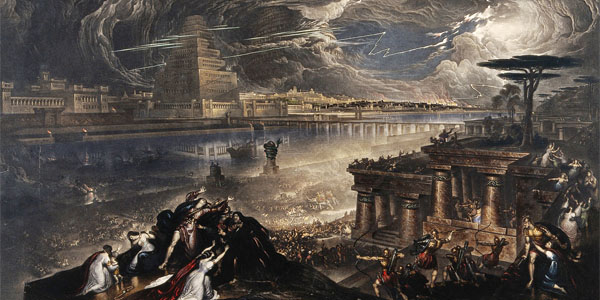
On verses 1-9: As Isaiah begins this oracle or “burden” concerning Babylon, he pictures the LORD summoning his troops to battle (v2-3) and how this massive army assembles from every end of heaven (v4-5), all in preparation for what Isaiah calls “the day of the LORD” (v6, 9). “The day of the LORD” is a phrase used by so many of the Old Testament prophets as well as by Peter and Paul in the New Testament. It refers to a time when God will finally pour out His wrath against those who have opposed Him, as Isaiah says, “a cruel day, with wrath and fierce anger” (v9).
What can we learn from this? Once again, the holiness of God comes with it a wrath against sin and evil. In His justice God will not let evil go unpunished forever. His wrath against sin is more ferocious than any sinner can bear if it were not for the cross where Jesus died.
Isaiah 13:10-22 (NIV)
10 The stars of heaven and their constellations will not show their light. The rising sun will be darkened and the moon will not give its light.
11 I will punish the world for its evil, the wicked for their sins. I will put an end to the arrogance of the haughty and will humble the pride of the ruthless.
12 I will make man scarcer than pure gold, more rare than the gold of Ophir.
13 Therefore I will make the heavens tremble; and the earth will shake from its place at the wrath of the LORD Almighty, in the day of his burning anger.
14 Like a hunted gazelle, like sheep without a shepherd, each will return to his own people, each will flee to his native land.
15 Whoever is captured will be thrust through; all who are caught will fall by the sword.
16 Their infants will be dashed to pieces before their eyes; their houses will be looted and their wives ravished.
17 See, I will stir up against them the Medes, who do not care for silver and have no delight in gold.
18 Their bows will strike down the young men; they will have no mercy on infants nor will they look with compassion on children.
19 Babylon, the jewel of kingdoms, the glory of the Babylonians’ pride, will be overthrown by God like Sodom and Gomorrah.
20 She will never be inhabited or lived in through all generations; no Arab will pitch his tent there, no shepherd will rest his flocks there.
21 But desert creatures will lie there, jackals will fill her houses; there the owls will dwell, and there the wild goats will leap about.
22 Hyenas will howl in her strongholds, jackals in her luxurious palaces. Her time is at hand, and her days will not be prolonged.
On verses 10-22: In 539 B.C. Cyrus, king of the Medes and Persians, defeated Babylon. Almost 200 years before this, Isaiah is saying here in verse 17 that Babylon would fall at the hands of the Medes. This is even more remarkable considering that in Isaiah’s time the Medes were not the most dominant force or an obvious choice. To this day, the site where the city of Babylon used to be remains abandoned, uninhabited and in ruins, just as verse 20 predicts.
Still there may be more to this passage. Earlier when we looked at Isaiah 7, we saw how Isaiah’s prophecy about a virgin giving birth to a child called Immanuel may actual be a prophecy with a double fulfillment, one in the short-term during King Ahaz’s time and one in the long-term with the birth of Jesus. It is also very possible that the prophecies contained in Isaiah 13 will also experience a double fulfillment: one in the shorter term and on in the longer term. That is because, long after the kingdom of Babylon was defeated in 539 B.C., we find the apostle John in the book of Revelation still speaking about Babylon. But the Babylon that Revelation is talking about is not the political kingdom that fell in 539 B.C. Rather, this Babylon has been interpreted by scholars to mean a variety of other empires. Perhaps more than anything “Babylon” in Revelation is taken to represent the spirit of false religion wherever it appears. Babylon is the spirit that leads billions of people to believe that they do not need Jesus and ought to worship something else, a spirit which in turn gives rise to a kingdom of its own. Revelation speaks repeatedly about how in the end times this “Babylon” will be overthrown.
So when you read here in Isaiah 13 about the destruction of Babylon and how this destruction seems to involve more than just one nation or one city but involves “the world” (v11) and “the earth” (v13), that may be because Isaiah 13 is not simply talking about the destruction of the ancient political kingdom of Babylon but the Babylon that exists today and in the future, the kingdom of false religion.
How can we apply this passage today? Since God sacrificed His most precious Son Jesus Christ to rescue us from our sins, God’s wrath is stored up against all those who live in “Babylon”, who think they don’t need Jesus’ help to reach heaven.
Father, thank You for Your Word which is not just timely but also ahead of our times. In Jesus’ name, AMEN!