
Isaiah 40:1-14 Click here for Bible Verses
Hi GAMErs!
Today’s passage is Isaiah 40:1-14. Let’s go!
Here in chapter 40 we come to one of the most beloved chapters in all of Isaiah. Some early church fathers (like Eusebius of Caesarea, Ephrem of Syria and Cyril of Alexandria) seem to have interpreted Isaiah 40 as an immediate response to Isaiah 39 where Hezekiah unwittingly reveals his nation’s top secrets to the Babylonians. This would have happened before 701 B.C. However, in the more recent centuries, Christian commentators have interpreted Isaiah 40-55 to be Isaiah talking about a much later event in the future, namely, the time from about 580 to 540 B.C. when the Jewish people were exiles in Babylon and how one day God was going to bring them back to their homeland of Judah. I will approach Isaiah 40 with this Babylonian exile in mind as the historical background for these verses. With this approach, I think you’ll find that, like a flower blooming, Isaiah 40 opens up in some beautiful and powerful ways.
Isaiah 40:1 (NIV)
1 Comfort, comfort my people, says your God.
On verse 1: The first half of Isaiah was very much about the judgment of God. But here at the start of the second half of Isaiah, the tone is very different: it’s about the comfort of God. Having judged and disciplined His people by sending them into exile in Babylon, God, like a loving father, is now in the mode of comforting them.
God is not only full of wrath toward sin. He is also full of tenderness toward His children. He is not only the just judge; He is also the compassionate comforter.
(By the way, Pastor David Pawson notes that “com-fort” literally means “with strength”. The comfort of God is not so much about coddling (“aw, poor you”); rather, it’s more about strengthening the person who is going through a tough time. God is less about coddling you and more about comforting (strengthening) you.
Isaiah 40:2 (NIV)
2 Speak tenderly to Jerusalem, and proclaim to her that her hard service has been completed, that her sin has been paid for, that she has received from the LORD’s hand double for all her sins.
On verse 2: What is the comforting message that God wants His people to know? It’s that their sins have been paid for and the punishment they deserved is done. For the Jewish exiles in Babylon, this was a hopeful message. This was God telling them that the punishment they received for their sins is completed and their time in exile will soon be at an end.
For us today, this verse is also a reminder that in Jesus Christ our punishment has been satisfied, our sins have been paid for and what we now receive is not God’s wrath but a double portion of God’s mercy and favour.
Isaiah 40:3 (NIV)
3 A voice of one calling: “In the desert prepare the way for the LORD; make straight in the wilderness a highway for our God.
On verse 3: Historians say that, in the ancient Near East, nations would build roadways and highways for their kings to travel on and to make an entrance into their most important cities. Those roads and highways needed to be level, broad, and smooth so that the king could travel into a city with as much ease and pomp as possible. (Apparently, this concept would not be lost on Italy’s Mussolini in the 20th century, who tried to build such a road into Rome for himself.)
It’s with this in mind that Isaiah writes of a voice calling, “In the desert prepare the way for the LORD; make straight in the wilderness a highway for our God”. Isaiah is saying that in the middle of a difficult wilderness season for God’s people, their king, the LORD Himself, was coming. God wanted His people to build a highway in their hearts for their King to enter in.
Likewise, the New Testament gospel writers saw this verse being fulfilled in the ministry of John the Baptist as he prepares the way for Jesus, our King of kings (Mark 1:3; Matthew 3:3; Luke 3:4).
What can we learn from this? Even when we find ourselves spiritually in a desert or wilderness, God the King wants to come in and fill our lives. That’s the incredible love, mercy and compassion of God. The verses that follow show us how we can build a highway for God to come in.
Isaiah 40:4-5 (NIV)
4 Every valley shall be raised up, every mountain and hill made low; the rough ground shall become level, the rugged places a plain.
5 And the glory of the LORD will be revealed, and all mankind together will see it. For the mouth of the LORD has spoken.”
On verses 4-5: When a road was being built for a king, valleys would be raised up, hills made low, and rough ground made level so that the road for this king would be as smooth as possible. The same goes for God the King when He enters our lives.
If we want God to have easy access to us, to fill our lives and to reveal His glory, we need to do the work of repentance. That means bringing up that which has been too low (whether it’s our lack of thanks and praise to God, or the way we look at God or ourselves), bringing down that which has been too high (like our pride), smoothing out our rough edges and confessing our sins – so that the Lord our King can come in. Repentance is the road to experiencing more of the King in your life.
Isaiah 40:6-8 (NIV)
6 A voice says, “Cry out.” And I said, “What shall I cry?” “All men are like grass, and all their glory is like the flowers of the field.
7 The grass withers and the flowers fall, because the breath of the LORD blows on them. Surely the people are grass.
8 The grass withers and the flowers fall, but the word of our God stands forever.”
On verses 6-8: Jeremiah had predicted that the Jewish people would be captives in Babylon for 70 years (Jeremiah 29:10). During this time, the Jewish exiles would have seen at least a couple generations of their leaders and elders pass away. God’s comforting message to His people is that while leaders in our lives will come and go and people will fall, the word of God stands firm forever. Heaven and earth will pass away but God’s word will remain. So don’t put your hope in people. Place your hope in God and His God’s Word.
One hundred years from now, if Jesus hasn’t yet returned, I will likely be gone, but the Word of God will remain and will be strength and hope for all who trust in Him.
Isaiah 40:9 (NIV)
9 You who bring good tidings to Zion, go up on a high mountain. You who bring good tidings to Jerusalem, lift up your voice with a shout, lift it up, do not be afraid; say to the towns of Judah, “Here is your God!”
On verse 9: God gives the Jewish exiles a mission which is: when you return to Jerusalem from Babylon, declare who God is to the people there (“lift up your voice with a shout, lift it up, do not be afraid”.
It’s a reminder that when we were exiled from God and separated from Him because of our sin, through Jesus Christ God rescued us and brought us home into His kingdom. Now we are not just saved, but we are called to share and declare this good news of who God is. As 1 Peter 2:9 says, “But you are a chosen people, a royal priesthood, a holy nation, a people belonging to God, that you may declare the praises of him who called you out of darkness into his wonderful light.”
Isaiah 40:10-11 (NIV)
10 See, the Sovereign LORD comes with power, and his arm rules for him. See, his reward is with him, and his recompense accompanies him.
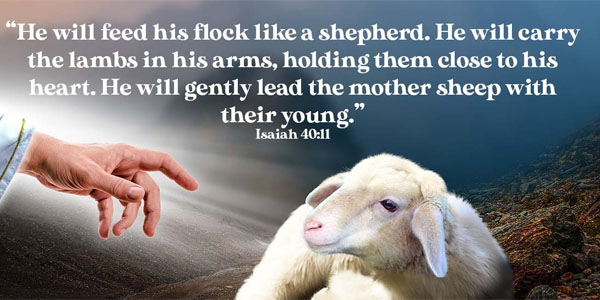
11 He tends his flock like a shepherd: He gathers the lambs in his arms and carries them close to his heart; he gently leads those that have young.
On verses 10-11: And who is this God that the people are to proclaim? What is He like? On one hand God is a strong and powerful king (v10). On the other hand, God is also a tender and gentle shepherd (v11). Praise God that He is both powerful and gentle. He is velvet and steel. That’s what makes the LORD the best leader.
Isaiah 40:12-14 (NIV)
12 Who has measured the waters in the hollow of his hand, or with the breadth of his hand marked off the heavens? Who has held the dust of the earth in a basket, or weighed the mountains on the scales and the hills in a balance?
13 Who has understood the mind of the LORD, or instructed him as his counselor?
14 Whom did the LORD consult to enlighten him, and who taught him the right way? Who was it that taught him knowledge or showed him the path of understanding?
On verses 12-14: Isaiah reminds the people that God is so great He is beyond our capacity to grasp how great He is. So whatever problem they were facing, their God is greater still.
Likewise, there is no way we today could fathom just how big, powerful and wise God is. His thoughts and plans are so vastly higher than our thoughts and plans, and He is able to do far more than all we could ask for or imagine. And whatever situation you may be facing today, it’s not too much for God; God is greater still.
Father You are strong yet gentle, powerful yet tender, and Your mind is far beyond our ability to comprehend. Thank You that in Jesus Christ my sin is forgiven, my punishment has been paid for and now I have a double portion not of Your wrath but of Your mercy and favour. Since You have saved me, I declare Your praises. In my life may You have a smooth, broad and level highway by which You can enter. Come fill me today. In Jesus’ name, AMEN!